Eviction Process in Texas: A Step-by-Step Guide for DFW Landlords
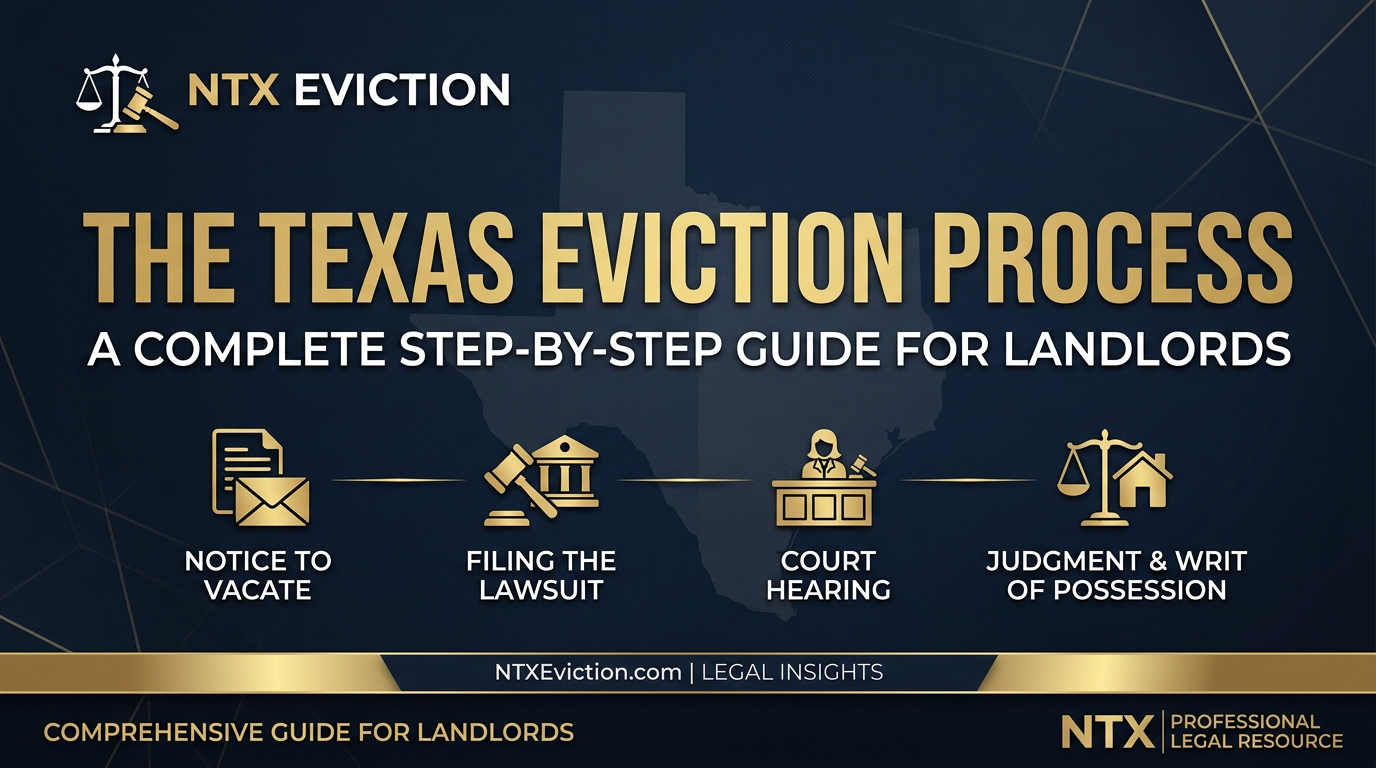
The eviction process in Texas is a court process governed by Chapter 24 of the Texas Property Code and Rule 510 of the Texas Rules of Civil Procedure. For Dallas–Fort Worth landlords, skipping a required notice, filing in the wrong precinct, or trying to "self-help" a tenant out of the property can delay the case — or expose you to liability.
This guide walks through the steps that apply to a typical residential eviction filed on or after January 1, 2026: written notice, filing in justice court, citation and service, the hearing, the five-day appeal window, and the writ of possession. It is practical information for landlords and property managers, not legal advice. NTX Eviction is not a law firm. We act as the landlord's authorized agent in justice court.
If you are ready to start, call NTX Eviction at 214-206-4229 or contact us. We offer flat-fee eviction services starting from $90.
How long does an eviction take in Texas?
There is no single clock that fits every case. An uncontested eviction — proper notice, timely service, no appeal — often runs about three to five weeks from the notice through a writ of possession. Court calendars, service delays, a tenant's appeal, or a federal notice period that has to run before the writ is served can add time.
This timeline reflects the default statutory timing for a standard eviction. Your lease, the justice precinct, and the facts of the case can change the dates.
- Notice to vacate, or notice to pay rent or vacate: At least 3 days by default, unless the written lease sets a shorter or longer period. The notice period must expire before you file.
- Filing the eviction suit: After the notice period ends, file a sworn petition in the justice court for the precinct where the property is located.
- Citation and service: After filing, the citation must be served at least 4 days before the hearing. Only a sheriff or constable (or another authorized officer, if the rules allow) may serve the citation.
- Hearing: 10–21 days after the petition is filed. The court sets that date on the citation.
- Judgment: Usually on the hearing date if the case is heard. A judgment for possession is what later supports a writ.
- Appeal window: 5 days after the judgment is signed. If the fifth day falls on a weekend or official holiday, the deadline generally moves to the next business day.
- Request the writ of possession: Generally not before the sixth day after judgment, or the day after the appeal deadline, whichever is later. A possession bond is a limited exception; an appeal can pause the writ.
- 24-hour writ notice and execution: The officer posts a written warning and may execute no sooner than 24 hours after posting. The officer must serve the writ within 5 business days after it is issued.
A writ of possession generally must be issued within 60 days after the judgment is signed (the court may extend issuance to 90 days for good cause) and may not be executed after the 90th day.
If the tenant appeals, the case moves to county court for a new trial. Under current law, the county court is to hold that trial no later than the 21st day after it receives the file — so an appealed case is often measured in additional weeks, not automatically in additional months. Complicated appeals can still take longer.
Step 1: Give the required written notice
The eviction process in Texas usually starts with a written notice under Texas Property Code § 24.005. If the occupant is a tenant under a written lease or oral rental agreement, you generally must give at least three days' written notice before filing a forcible detainer suit, unless the parties agreed to a different notice period in a written lease.
The form of that notice matters, especially after the 2026 updates:
- First-time nonpayment of rent (the tenant was not late or delinquent before the month in which you give the notice, and you are evicting solely for nonpayment): the notice must be a notice to pay rent or vacate.
- Repeat late payment (the tenant was already late or delinquent before that month): you may use either a notice to pay rent or vacate or a notice to vacate.
- Other lease violations, or holdover after the lease ends: a notice to vacate is the usual statutory form. If the tenant is holding over after the end of a term, you must also comply with the tenancy-termination rules in Texas Property Code § 91.001 — that is a separate requirement from the three-day (or lease-stated) notice to vacate.
Delivery must use at least one of these methods:
- Mail, including first-class, registered, or certified mail, or a delivery service
- Delivery to the inside of the premises, in a conspicuous place
- Hand delivery to any tenant of the premises who is 16 or older
- Electronic communication (email or other electronic means) only if the parties have agreed to that in writing
If the tenant actually receives the notice, the statute's delivery-method list does not have to be the method that was used. Posting a notice only on the outside of the door is no longer a listed statutory method.
Special situations can change the notice: a tenant at will or by sufferance, certain foreclosure purchasers (often a longer residential notice), and properties covered by a federal notice rule. On federally required notices, Texas law generally lets you file without waiting for the federal period to run, but a writ of possession may not be served until that federal period has been satisfied.
NTX Eviction can prepare and serve the notice so this first step is done in a form the court can work with. For notice wording and delivery detail, see our notice to vacate requirements guide. Text or email notice is not a substitute unless your lease has a written electronic-notice agreement.
Step 2: File the eviction lawsuit in justice court
If the tenant does not leave (or, in a pay-or-vacate case, does not timely pay) after the notice period expires, the next step is a forcible detainer suit — the formal eviction lawsuit.
- File a sworn petition in the justice of the peace court for the precinct where the property is located. That venue rule is statutory. Filing in the wrong precinct can stall or sink the case.
- The petition must describe the premises, the grounds for eviction, when and how pre-suit notice was given, and whether it was a notice to vacate or a notice to pay rent or vacate. If rent is unpaid, the petition should state the amount due at filing.
- You may join a claim for unpaid rent in the same eviction lawsuit if the unpaid rent is not more than $20,000, excluding statutory interest and court costs but including attorney's fees, if any.
- In justice court, the parties may represent themselves or be represented by their authorized agents, who need not be attorneys. That is why a landlord can hire NTX Eviction to appear as agent — we are not attorneys and do not give legal advice.
Court filing and service fees are set by each county and change over time. Do not rely on an old fee you saw online; confirm current costs with the justice court and the constable or sheriff who will serve the papers.
Step 3: Citation and service
After the petition is filed, the court issues a citation. The citation tells the tenant the case number, the relief you are seeking, and the date they must appear for trial.
Two timing rules control this stage:
- The trial date on the citation must be not less than 10 days and not more than 21 days after the petition is filed.
- The citation must be served on the defendant at least four days before the hearing. A citation cannot be served on a Sunday.
Only a sheriff or constable may serve an eviction citation, unless the rules allow another trained law-enforcement officer when the sheriff or constable cannot complete service. Alternative service to the premises is allowed only when the judge authorizes it after documented attempts at personal service.
If the tenant is not properly served, the court should not go to trial on the original setting. Build in time for service, especially in busy Dallas, Tarrant, Collin, Denton, and Kaufman precincts.
Step 4: The eviction hearing
The hearing is usually short and focused. The justice court is deciding the right to current possession, not a full title dispute or a wide-ranging civil case. Counterclaims and joining third parties are generally not permitted in an eviction suit.
Be ready to show:
- That you (or the plaintiff you represent) are entitled to possession
- That the required notice was given in the right form, for the required period, and by an allowed method
- The facts that support eviction — unpaid rent, a lease violation, or holdover
- A clear description of the premises
Both sides may appear. If the parties agree, some justice courts may allow appearance by videoconference or other electronic means. If the tenant does not appear after proper service, the court may enter a default judgment.
For certain forcible-entry cases (including some unauthorized-occupant situations), Texas law also provides a summary disposition path without a full trial if the sworn motion and any response show there is no genuine factual dispute. That is not the typical nonpayment eviction, and it is not a shortcut around notice and service. Unauthorized occupants can also involve Chapter 24B, which is a different statutory track than a standard Chapter 24 eviction. See our guide to evicting unauthorized occupants in Texas.
Step 5: Judgment and the five-day appeal window
If the judge rules for the landlord, the court signs a judgment for possession (and, if you pleaded and proved it, a judgment for unpaid rent). The tenant then has a short, strict window to appeal.
A party may appeal by filing a bond, a cash deposit, or a statement of inability to afford payment of court costs with the justice court no later than the fifth day after the date the judgment is signed. When you count that period:
- Do not count the day the judgment is signed
- Do count weekends and official holidays
- If the fifth day is a Saturday, Sunday, or official holiday, the deadline generally extends to the next day that is not a weekend or official holiday
A tenant who appeals must also affirm, under penalty of perjury, a good-faith belief that the tenant has a meritorious defense and that the appeal is not for delay.
If the appeal is perfected, the case goes to county court for a trial de novo — a new trial, not a rubber-stamp of the justice court's notes. In a residential case, the justice court also determines the rent to be paid during the appeal and notes that amount in the judgment. Failure to pay rent into the court registry as required can allow the landlord to ask for a writ even while an appeal is pending. The county court is generally required to hold the trial no later than the 21st day after it receives the transcript and original papers.
For the mechanics of an appealed case, see our eviction appeal page.
If no appeal is timely filed, you can move to the writ.
Step 6: Request and execute the writ of possession
A judgment for possession is not the same thing as getting the keys back. Lawful removal is done with a writ of possession executed by a sheriff or constable — not by the landlord changing locks.
Key timing rules:
- A writ generally may not be issued before the sixth day after the judgment for possession is signed, or the day after the tenant's appeal deadline, whichever is later, unless a possession bond applies.
- Issuance of the writ is a ministerial act. A sheriff or constable must serve the writ no later than the fifth business day after it is issued.
- The officer must post a written warning (at least 8½ by 11 inches) on the exterior of the front door stating that the writ will be executed on or after a specific date and time not sooner than 24 hours after the warning is posted.
- A writ generally may not be issued more than 60 days after the judgment is signed (extendable to 90 days for good cause) and may not be executed after the 90th day.
When the writ is executed, the officer restores possession to the landlord, instructs the tenant and occupants to leave, and oversees removal of personal property according to the statute. The officer may not require the landlord to store the property, though a warehouseman may be used at the officer's discretion.
If an appeal was perfected and any required rent is being paid into the registry, the writ should not issue until that appeal is resolved or the rent-on-appeal rules allow it.
Nonpayment of rent vs. other lease violations
Most DFW evictions are for nonpayment of rent, but the process is not identical for every ground:
- Nonpayment: Use the correct notice form (pay-or-vacate vs. notice to vacate, as described above). Keep a clear rent ledger. You may ask the justice court for possession and unpaid rent in the same suit, subject to the $20,000 cap.
- Other lease violations (unauthorized occupants who are still under a tenant's lease, pets, illegal activity, property damage, and similar breaches): The notice is typically a notice to vacate. Whether the tenant has a contractual chance to cure depends on the lease and the facts — Texas Chapter 24 does not use California-style "cure or quit" as the official statutory label. Bring the lease and proof of the violation to the hearing.
- Holdover: Ending a periodic tenancy and evicting a tenant who will not leave are two related steps. Comply with § 91.001 when you terminate the tenancy, then give the § 24.005 notice to vacate before you file.
- Unauthorized occupants / squatters: Some situations belong under Chapter 24B or a forcible-entry theory, not a standard tenant eviction. Do not assume the three-day tenant-notice playbook applies to every occupant. Start with our unauthorized occupants guide.
What the eviction process costs
Expect three categories of cost, and confirm each one locally:
- Court costs, including the filing fee and any required service or citation fees, which vary by county and can change. We do not list a statewide filing-fee range here because it would be quickly out of date.
- Writ and officer fees for posting and executing the writ of possession, which also vary by county and by the constable or sheriff's office.
- Professional help. NTX Eviction offers flat-fee eviction services starting from $90. That is our service fee, not the court's fee.
An appeal in county court adds its own filing, bond or registry, and timeline costs. Ask the court clerks — or us, when we are handling the file — for the current amounts in your precinct.
What landlords must not do
Texas law does not let a landlord skip the eviction process and recover a residential rental by force. In particular, do not:
- Change the locks, padlock the doors, or otherwise lock the tenant out to force a move-out
- Shut off electricity, water, gas, or other utilities to push the tenant out
- Remove the tenant's belongings, seize property, or "move them out" yourself
- Threaten, harass, or shut off access to common areas as a substitute for a court case
- Rely on a notice posted only on the outside of the door as your official service method
Those self-help tactics are not a faster eviction. They can lead to a lockout or utility-interruption claim under Texas Property Code § 92.0081 and related provisions, including a tenant's right to seek reentry and damages. The lawful way to regain possession after judgment is a writ of possession executed by an officer. For more detail, see why self-help lockouts are illegal in Texas.
Start the eviction process with NTX Eviction
NTX Eviction helps Dallas–Fort Worth landlords and property managers move through each step — notice, filing, court appearance as your agent, appeal follow-through, and the writ of possession — so the file stays on the statutory path.
Call 214-206-4229 or contact us to get started. We offer flat-fee eviction services starting from $90. Our services are for landlords and property managers only.
NTX Eviction is not an attorney's office and is not a law firm. We act as a landlord's authorized agent. This article is for general information for Texas landlords and is not legal advice. Eviction procedures can depend on your lease, your county, and the facts of the case. Consult a licensed Texas attorney if you need legal advice.
Frequently Asked Questions
Need Professional Eviction Help?
NTX Eviction handles every step of the process. Call for a free consultation.